Sabre Edge Features 
Shining Through: The History Of UVa's Colors
Special To TheSabre.com
Apr 07, 2010
![]() |
1900's football uniform |
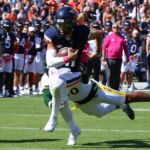
With the recent news of University of Virginia football coach Mike London introducing multiple new uniform designs for the 2010 season, I thought this would be a great opportunity to tell the winding history of UVa's school colors - from the athletic teams' formative years in the mid-19th century through today.
While this topic will be covered in my upcoming documentary Wahoowa: The History of Virginia Cavalier Football (which will include a fascinating part about the school colors I won't include here - trust me, it's great), I did want to take this opportunity to go into a little more depth here than I am able to do in the documentary. The biggest trouble my production team is having now with the film is trying to cut it down to a manageable two-hour running time. There are so many great stories to tell that we could make this an eight-hour film, but who can sit still that long?
So, occasionally I will share articles like this one with my friends at TheSabre.com, which will allow me to go into greater detail and give you the full story on a topic that you may not have known. In this case, let's start with UVa's school colors: the illustrious orange and blue. Some knowledgeable fans - or visitors to The Sabre's Wahoowa! Traditions page - may know that UVa's former color scheme was "silver grey and cardinal red," symbolizing Confederate uniforms and the blood that was shed on them.
According to an article by Professor William Echols in the 1914 Corks & Curls yearbook, "One-half century ago, tramped a team of athletes clothed in grey, bearing a blood-red battle flag - men to whom the sting of death was but a triumph, and the grave a victory." After the Civil War, a great majority of young men attended the University who were the sons of these Confederate "athletes," if not the actual veterans themselves, as many had fought for the South at the tender age of 15.
During the Reconstruction Era there was not a lot of enthusiasm for sports at the University. The students had little money for uniforms or equipment and only stayed in school for one or two years for an "education" before heading off to rebuild their homes and towns. But as sports such as rowing and baseball began to pick up attention, the students' continuing sense of honor to their home states led them to say, according to Echols, "From Virginia to Texas ... we can show our gratitude and appreciation ... by bestowing upon Her, as Her entitled and endowed colors, the bloody grey uniform of her soldier sons."
From 1861-1887 students and faculty wore the colors with great pride. When they bought new straw hats each spring, the bands around the brim were made of cardinal red and gray ribbon. The crew and baseball teams wore these colors and men wore them on their coats. There was even a brand of cigars manufactured in Albemarle County called "The Silver Greys" that became well-known throughout the South and, at the time of Echols' 1914 article, remained "the only evidence of this sentiment."
So what happened? As Echols described it, a few "callow youths in charge of a football team, about 1888, permitted themselves to be persuaded, by a Yankee manufacturer, that the red and grey would run, and therefore substitute for them a streak of yellow and the federal blue!"
Who was this "Yankee manufacturer?" Was it a textile merchant who got into the ear of one of the students in an attempt to try and drum up business? We'll never know. Was it true that when soiled with the red clay of Virginia on the playing fields, the gray uniforms turned to an embarrassing pink? Or was it the red dye that began to fade to pink after washing? Obviously Echols ignores the color orange in his rant and focuses on the "federal blue," even calling out the students as "yellow" for their ignoble lack of courage in holding fast to the University's original colors.
In any case, we do know that the very first football team in 1887 wore these "cardinal red and silver grey" uniforms (yes, UVa athletics has marked the 1888 team as the first group of footballers, but we'll correct that mistake in the documentary, too). And in buildup to the second season, as practice began in the fall of 1888, a student meeting was called about the school colors.
![]() |
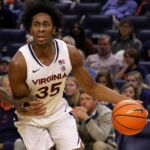
These days Wahoo fans show their colors with everything from scarfs to ties. |
On his way to practice that day was Virginia player Allen Potts, who stopped to attend this gathering where potential new school colors would be discussed. Dressed in his football clothes, he also wore a large silk handkerchief, with orange and navy blue stripes, that he obtained the previous summer while visiting Oxford University in England. As the legend goes, a student behind him reached over, pulled the handkerchief from his neck, and waved it yelling "How will these colors do?" The crowd liked the suggestion and the decision was made that very day.
First, let's talk about Potts. Allen Potts, according to Jennings Culley, the Richmond News Leader's legendary sportswriter from the 1940s-1990s, was a "19th-century version of Bo Jackson. He was without a doubt the best and most versatile athlete on the Virginia roster."
Potts played second base for UVa' s baseball team, and at the school's "Athletic Games," a track and field competition open to all students, he won six events: the 100-yard dash (10.375 seconds), the 440 (68 seconds), the three-mile run (19 min 25 sec), the 140-yard hurdles (21.75 seconds), the baseball throw (290 feet) and the running broad jump (16'-8.75"). He was your basic B.M.O.C. Not to mention, he later went on to become a Lieutenant Colonel in WWI, and the Managing Editor of the Richmond Times-Dispatch and later the Vice President of the Richmond News Leader.
With Potts being such a popular student, it's not a surprise that the colors were chosen with such enthusiasm. Potts could have been wearing burgundy and burnt orange and those colors might have won favor (UVa fans will shudder to consider this), so let's take relief that he visited Oxford the summer before. But wait, you say, Oxford's colors are blue and white. Where did the orange come from? A good guess comes from our friends at Auburn, where in 1892 Professor George Petrie, who graduated from UVa in 1887, started the first Auburn football team. It seems when trying to decide on colors for Auburn's uniforms, someone suggested Mr. Petrie's former school's orange and blue.
Some inquisitive investigator at Auburn recently has found that Allen Potts' joined the Oxford Rowing Club in England that summer and may have competed against the Grosvenor Rowing Club who, since 1869, has used orange and blue as its colors. In the summer of 1888, Grosvenor wore silk boating scarves (actually worn around the waist like a belt, but misworn by Potts around the neck). As was the custom, after a race the victors were allowed to trade an article of clothing with the team they defeated. It is believed that Potts may have swapped his Oxford Blue rowing scarf for one of Grosvenor's orange and blue scarves.
The handkerchief worn by Potts in 1888 had a further impact on college football, as years later a sundry-store owner on the University of Florida campus would come to visit his son who was attending UVa. When looking in a Charlottesville store for a pennant to sell to Florida fans back home, his son came up with the idea of the "Gator," a native Floridian reptile, as the mascot. When the Charlottesville factory delivered the Gator-clad pennants to Florida that fall, they consisted of an orange alligator over a navy blue background, as those were the only colors the factory had in stock ... used for the hometown UVa pennants.
![]() |
1900's football uniform |
While the students approved of the new orange and blue colors in 1888, not everyone was happy. In 1891 a letter in the student newspaper College Topics (now called The Cavalier Daily) called for a change back to the "cardinal red and silver grey." Professor Echols, in response to the color change even before his 1914 Corks & Curls article, exclaimed "The bloody gray of the old Confederate was good enough for the first generation and it remained for a younger to discern that it would be better, in imitation of Princeton's orange and black; and here comes Princeton saying that her real colors are orange and blue." Perhaps Princeton envied the orange and blue uniforms that Virginia players sported in their 1890 contest in Baltimore, just two years after Allen Potts' attendance at that fateful meeting?
Talk of school colors died down for the next 67 years, until in 1955 another letter calling for a return to the original colors was featured in The Cavalier Daily, this time by Harrison Pemberton: "Navy blue, a color that seems to lack the courage to be a wholehearted black ... A garish orange, a color without the vitality to be a hearty red ... Yes, like egg stains on the vest of a blue serge suit."
This resulted in a reply from The Cavalier Daily Managing Editor: "We had never realized that the colors were established by a 67-year-old rather than 130-year-old tradition. Perhaps the information that the colors are relatively untraditional will set off a landslide of criticism." It seems that in 1955, like today, UVa fans weren't aware of the entire story regarding the colors.
A follow-up letter to the paper made reference to the colors and the wrestling team's dilemma: "Since its present uniforms, which have done more to frighten opponents than the wrestlers themselves, have finally fallen victims to moths and old age, there has resulted an unending dispute among the teammates concerning a design for the new uniforms. The fact is, you just can't do very much with the good ole orange and nasty blue, a cross between nausea and Monday morning hangovers." First off, sound familiar to the "Oregon of the East" cries that have resulted from the recent news of the 2010 football uniforms? And second, who's drinking that hard back in 1955 that the hangovers last until Monday?
After this most recent round of Cavalier Daily articles, Professor John Forbes made a formal request to the UVa administration in 1959 to determine what in fact the true school colors were. An exhaustive search of the archives, including President Edwin Alderman's personal papers, revealed some interesting answers.
In March of 1825, the University first opened its doors for classes. A few years later in 1828, University diplomas were donned with a ribbon of "Cadet Blue." This lasted 77 years until 1906, when the diplomas were changed to include an orange seal. The 1959 search committee seemed surprised that the Board of Visitors had never taken any action regarding the University colors. The "silver grey and cardinal red" had never been used officially according to the committee. They were only "adopted by the University's boat crews several years after the Civil War. The nearest thing to official use of gray and red that is known is the gray and red academic hood used by the recipient (1885) of the University's first Ph.D. degree, Dr. Samuel Marx Barton."
The committee concluded there were "five traditional University colors: cadet blue, cardinal red, silver gray, orange, and dark blue. Three of these colors (cadet blue, 1828-1904, and orange and blue, 1906-1959) have been sanctioned by official use. None have been given official approval by formal act of Faculty or Board. For some reason (possibly loyalty to our first Rector, who once declared that a coat-of-arms could be bought as cheaply as any other coat) both Faculty and board have heretofore maintained an attitude of lofty indifference to such heraldic matters as University colors. They were left to student boat crews and football players. You and your committee appear accordingly to have a clear field and a variety of choices. All you have to do is sell your product to the Faculty and Visitors."
| |
I guess we know where the crew and football teams stood in the minds of this committee. Perhaps it was because in 1959 UVa was in the middle of its then-NCAA-record 28-game losing streak (another story for the documentary).
Not only did the opposition to the orange-and-blue think that the 1888 student group was ignorant (Echols' thoughts), but also that those students lacked fashion sense (Mr. Pemberton's sentiment) and proper authority (the 1959 search committee's feeling).
Like the evolution of many color schemes and logos, the orange and blue happened by chance. There was no thought as to branding of a football team or a University back in 1888. The Coca-Cola logo had only been created three years before, and in 1888, three separate companies were selling it. It was a fluke that gray and red turned to pink, that a star athlete in 1888 had gone to Oxford for the summer, won a boating contest, chose a scarf as his prize, wore it to football practice, and another student had the thought to take it off his neck and hold it up for all to see.
It looks like arguing over the University of Virginia's school colors is a time-worn (pardon the pun) tradition, which seems to be ongoing to this day - maybe not with respect to gray and red versus orange and blue, but with jersey and pants combinations and helmet stylings. The more things change, the more they stay the same.
I'll give Professor Echols the last word in this debate, if anything to just honor the past and how strong emotions become when change occurs:
"Men may forget and ignore the spiritual trifle of a sentiment, but women do not. If one examines the certificate of membership to the Daughters of the Confederacy, he will find attached to the seal the abandoned colors of the University of Virginia, the cardinal red and silver grey ribbon. There is no bugler now to sound a rally to these colors: only the horns of elfland faintly blowing, or some faint and far away Aeolian harp to sing their requiem to those who held them dear."
About The Author: Kevin Edds is the Writer/Director of the upcoming documentary Wahoowa: The History of Virginia Cavalier Football, set to be released this November. For more information on the film, please visit www.UVaFootballHistory.com. TheSabre.com is pleased to introduce a new series on the history of UVa football where Edds, an alumnus, will highlight some of the most interesting moments in the more than 120-year history of the South's oldest football program. Email Kevin here.
|
|
|